Author: stickhead

  • Thorin sits down and starts singing about gold

    Thorin sits down and starts singing about gold

    The Joy of Stacks 23/11/25 – Where else would arms go? | Spin to not win | Sunday papers

    The Parser Knows

    I really, really want to get into text adventures. Really.

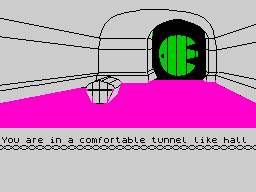
    I have briefly fumbled about with one or two. Tried things, got misunderstood, started typing in swear words. A bit like most of my relationships. I played a little Hobbit on the ZX Spectrum, I played a bit of Ooze on the ST. I got absolutely nowhere near completing or even making decent progress in either. I’m not sure where or when this little itch, this knot of unfulfilled something began burrowing into my psyche, but it sure is getting annoying. It might have something to do with the two rather evocative bookend scenes from Big. You know the movie. The film where a kid makes a wish to be big and becomes Forrest Gump. The one with the chopsticks piano bit in FAO Schwarz. The one that makes you feel really uncomfortable by including a sex scene between a woman and a prepubescent teen (albeit with a grown man’s visage).

    Here’s the bit I’m talking about:
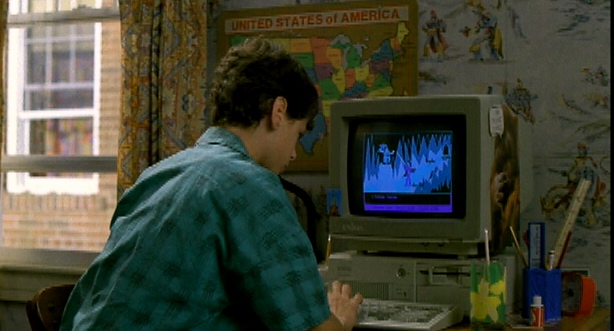
    What's the video game in the movie "Big" - Arqade
    Melt wizard with what, you nob-end?

    Little Tom can’t solve the puzzle at the beginning, but when he comes back from his adult adventures, he rinses it. It’s an allegory or something.

    (By the way, Little Tom’s game isn’t a real game, but has been made playable by someone with far too much talent and far too much time on their hands.)

    Another formative experience that may have an influence on my misty-eyed, unrequited love of text adventures involves some of my earliest video game memories. Like many primary schools in the early eighties, my school was home to many BBC Micros. Upon these black, red and beige marvels could be played two games: The first was Granny’s Garden, an edutainment graphical adventure game with text elements and the second was Podd, which was not really a game, but more of an interactive toy where you could type in verbs to see if the weird on-screen alien guy could do them. ‘Pod can explode’ was particularly fun with the BBC’s extremely loud built in speaker.

  • I will Bolo him, Bolo him wherever he may go

    I will Bolo him, Bolo him wherever he may go

    The Joy of Stacks – 16/11/25 – Megan’s Twin | Follow the Tiger Road | ARChive | Oh Mummy! | Erik ‘Steve’ Simon

    Bolololololololo

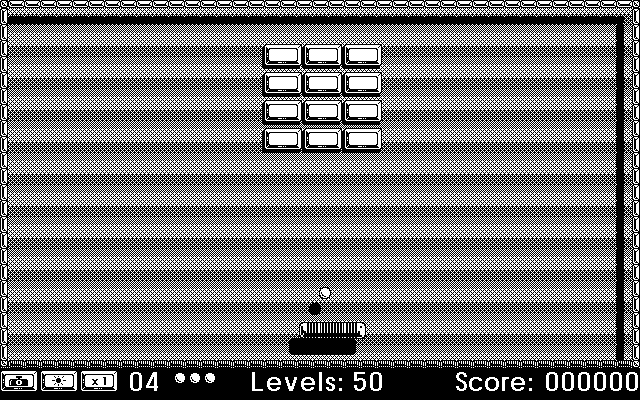
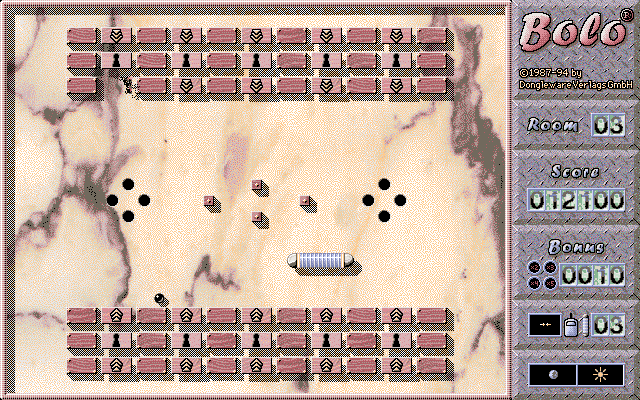
    Bolo’s a strange one. Ostensibly, it’s a Breakout clone. But it’s so much more than that. It’s more even than just an Arkanoid clone. In fact, it blows Taito’s iconic ball-and-bat-em-up out of the water entirely. You’d be Batty not to try it.

    Published by Application Systems Heidelberg and developed by Meinolf Schneider to be played on either a mono, high resolution or colour, low resolution monitor (but far crispier in mono, it must be said), Bolo takes the bat and ball genre and runs with it. A very long distance. You could say it’s the Dean Karnazes of the genre.

    Bolo atari screenshot
    Looks simple? (laughs in Schneider)

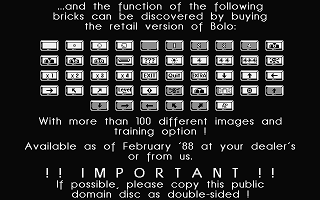
    Bolo is mouse controlled and allows you to freely move with precision in both dimensions (yes, all two of them). This alone would make it a remarkable entry into the canon, but there’s more. After a gentle introduction to how the game works, it starts hitting you with new gameplay mechanics. There are blocks that unleash deadly enemies when you hit them. There are blocks that add and then increase the gravitational force enacted on the ball when you hit them. There are blocks that can only be destroyed by direct contact with the paddle. There are blocks that will send you back a level if you hit them. Bolo has something in common with the very best puzzle games: it introduces cool mechanics and then plays with them through excellent level design. And I’m here for it.

    Bolo atari screenshot
    We’ve got a block for that

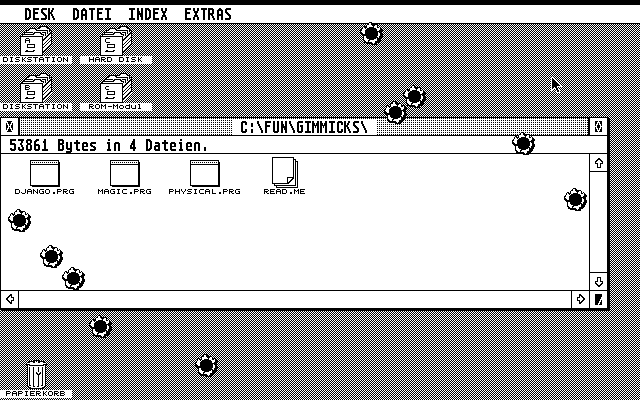
    Mr Schneider only ever made three games for the ST: Bolo, Oxyd and Esprit. All with his signature mono, high res, beautifully bestippled and beveled style. He did also create some fun little screensaver-ish desktop toys for the ST. Here’s one which allows you to shoot up your GEM desktop. Handy for those particularly frustrating debugging sessions, I’d imagine:

    Take that READ.ME file! Don’t tell me what to do!

    Meinholf Schneider would go on to found his own software company known as Dongleware Verlag and then produce a version of Bolo for DOS which seems to have similar gameplay but a very different aesthetic:

    Bolo (DOS) screenshot: Gameplay - Level 2
    Good to see the stippling still present and correct

    We’re playing the ST version as part of STOT season 7, round 11. Come and have a go if you think you’re hard enough.

    References

    The Sunday Papers

    This Week’s TJoS Videos

    They’re twins! They’re… well… sort of decent chaps, I suppose

    After playing ST games for the best part of three decades, it’s nice when a game that is relatively unknown to you turns out to be pretty decent. During my recent sortie into the realms of Capcom’s arcade conversions on the ST, I was getting used to games being ‘good if…’ Games that are ‘this close’ to being good, if only it wasn’t for some oversight or glitch or bad design choice. This one has a pretty decent bash at porting over what makes the original coin-op a quirky and interesting game.

    That’s right, that’s right, that’s right, that’s right, I really am indifferent to that Tiger Road.

    This game looks terrible in screenshots. In the flesh, it’s a pretty good representation of the arcade original, but faithfully recreates the tedium of the original game and adds a few more annoying quirks for good measure. The ST version has a natty tune at least. And the cutscene that shows your hideous child being carried away by a death knight or something is pretty cool.

  • No scrolling, please, we’re British

    No scrolling, please, we’re British

    The Joy of Stacks – 9/11/25 – Super Sprinting | Historically inaccurate shooting | Lovely things to read and watch

    Arcade conversions on the ST

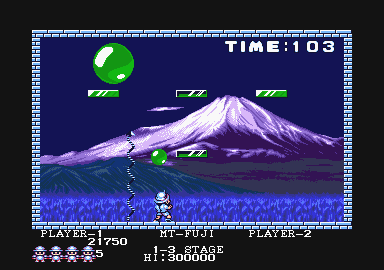
    Pang atari screenshot

    Here are some of my absolute favourite arcade conversions on the Atari ST:

    • Pang

    • Joust

    • Bubble Bobble

    • Super Sprint

    • Bombjack

    • Volfied

    • Rodland

    Notice anything? I mean, apart from my undeniably good taste… Yes, that’s right! All of these games are single screen games that involve absolutely no scrolling whatsoever.

    The ST is a notoriously stubborn beast when it comes to corralling it to scroll (have a look at what Jonas has to say about coding planar graphics via the link at the bottom of this newsletter for hint as to why). Not that scrolling is completely out of the question on the ST. There are plenty of examples of ST games and demos doing it as smooth as butter, but there is no doubting that many developers struggled to get it working adequately on our favourite rhombus keyed wonder. Just look at the recent videos of Capcom games on my channel (LED Storm and Last Duel) to see how some developers deal with this difficulty. Flipping hell.

    So I think it comes as no surprise that some of the best arcade conversions on the machine, and some of the best games full stop (you can add Llamatron and IK+ to the above list) do not demand the developers run the gauntlet in order to get smooth horizontal movement. In the interests of balance, I’ve heard many programmers wax lyrical about the joys of developing on a system with open architecture like the ST has. Just you, your coding environment and the bare metal. It’s what a hacker’s dreams are made of. So the lack of scrolling hardware is a curse to some, but a boon to others.

    I think the ST’s hurried and low-cost conception has a lot to do with this. It was brought to market quickly, and using many off-the-shelf parts and an OS hastily found and modified, not specifically made for the system. There was to be no dedicated hardware for sprites or scrolling. At the time of release, arcade games were not that demanding, especially for a 16-bit 8Mhz processor such as the Motorola 68000, but the arcades were rapidly developing. At the time of the ST’s release, the most popular arcades were games like Yie Ar Kung Fu, Bomb Jack and Punch Out, but in just a few short years, Final Fight, Strider and Golden Axe were more typical of what was popular in arcades; games that rely on throwing large sprites around on moving backgrounds to deliver the thrills and spills the more discerning arcade gamer demanded.

    Sometimes I feel the ST was designed for the early to mid 80s. Didn’t stop me from falling in love with one in 1988, though.

    This Week’s Joy of Sticks Videos

    This one is the second video in the ‘Conversion Capers’ series. It’s a series where I look back at a favourite ST game of mine and then see how it runs on a variety of other systems.

    The other versions of Super Sprint are not as consistent as they were for IK+ (last week’s Conversion Capers) but they are still really well put together and there is plenty of fun to be found.

    Moving on to the next Capcom conversion on the Atari ST. This week it’s 1943 – The Battle of Midway. The arcade version is a seminal shoot ‘em up (despite what the reviewers say, spoiler alert) and it’s interesting to find out what features make it across to the ST version and which ones do not. It’s once again a case of close, but not quite.

    The Sunday Papers

    Here are some words and pictures that I enjoyed looking at this week:

  • Games with keyboard controls

    The Joy of Stacks – 2/11/25 – Midnight Resistance is rather good actually | It probably isn’t the Last Duel, is it? | Karate supplements | ST reading list

    Keyboard controls

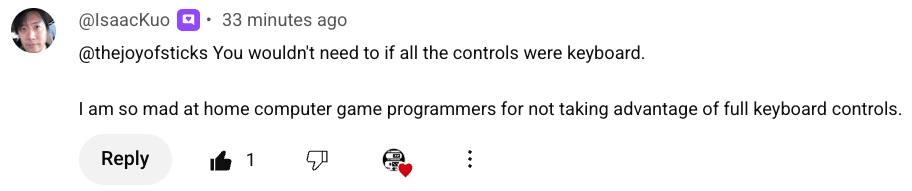
    I had a little chinwag with subscriber Isaac this week. A conversation into which he dropped this little nugget after I bemoaned games that require you to take your hands off your joystick to give your space bar a reacharound:

    It turns out, there are people out there who miss the glory 8-bit days of keyboard controlled wonder. Personally, I left keyboard controls behind when I jumped from the Acorn Electron to the Amstrad CPC in the late eighties, only briefly returning to the qwertys for a bit of Super Sprint or Trapped 2.

    This got me thinking: are there any games on the ST where you can choose to play via keyboard? Sure, thanks to the modern marvel that is emulation, you can assign any input to any key and turn any game into a keyboard controlled game, but where are the ST games that shipped with the option baked in?

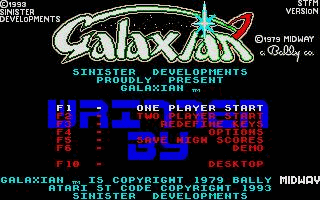
    I’ve mentioned the two above, and I know the ST version of Galaxian allows you to define keyboard controls very similar to the manner in which 8-bit computer games worked (see screenshot below) and there’s always Thrust. Ah, Thrust (I love you 😘).

    I’ll take ‘ZXMK’ please, none of your ‘QAOP’ nonsense

    You can execute a search on Atarimania for games with keyboard controls which kicks up 2,602 games, but unfortunately, these are games with keyboard controls, not games that give you an option to play only on keys.

    So, over to you, dear readers. Can you think of any Atari ST games that give you the option to play on keyboard? And is this a feature you miss from the good old days?

    Midnight Resistance is Futile

    So… are we resisting midnight? Or Resisting something else, but only at midnight? Did I miss a meeting?

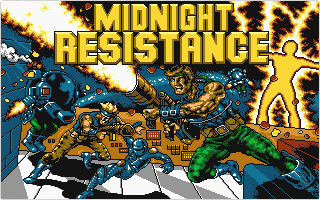
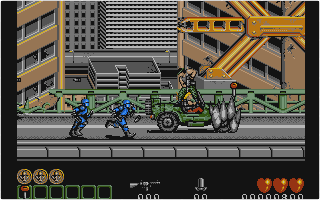
    This month’s STOT (the ST Offline Tournament, a monthly Atari ST score attack competition, see here for more details) focuses on the rather nifty arcade conversion of Data East’s Midnight Resistance. STOT is always a good time, and I highly recommend you jump in, but playing this game repeatedly has given me a new appreciation of just how good this game, and the ST conversion, is.

    It’s programmed by Joffa Smith, a legend of the industry known for super tight ZX Spectrum coding, and it’s a real shame that he didn’t do more on the ST as the conversion here is top notch.

    Midnight Resistance should have been a problem for home systems as the arcade implemented a control scheme similar to Ikari Warriors – the rotating joystick. Players could move their avatar as per usual, but also direct their fire in 8 different directions while doing so thanks to a twist of the wrist. Of course, this presents a problem to a developer porting the game to home systems – how do you implement this extra axis of control on a bog-standard stick?

    Look mum! I can shoot in eight directions independent of my direction of travel… sort of.

    Ikari Warriors implemented a toggle mechanism. You could fire in the direction of travel, or tap a key to lock your fire in a single direction. All well and good, but that wouldn’t work for a run and gun game like Midnight. Instead, Smith implemented a scheme whereby you can direct your fire with a press in the corresponding direction, but you can also modify that direction with taps on the joystick that slowly rotate the direction of fire in that direction.

    It’s not a perfect solution: there is a bit of a hump to get over when first picking up the game and there are many moments when you want to change direction of fire but end up jumping into enemy fire. It is also impossible to travel in one direction and fire in another, but overall, it’s a great solution to the age old problem of squeezing bespoke arcade controls onto a limited home controller.

    I highly recommend you give Midnight Resistance a try. It has a very tight control scheme, is responsive and smooth to play, has a cool shop and power-up system and each level kicks up something innovative and new: there’s always a surprise or two around the corner.

    Sunday Papers

    Here are some words and pictures that I enjoyed looking at this week:

    • Steve’s written a bloody thesis on Heroes of the Lance. S’about time someone did.

    • The Atari Basement plays host to Computer Hits Volume 2 this week, and blow me! It’s Tetris! On the ST! But who threw up on the background? Ssshhh… just close your eyes and let Mr Whittaker soothe your soul.

    • Gears of Games was diving into old ST shoot ‘em ups earlier this week. He played Typhoon. And he cheated. Unbelievable.

    • Over the pond we go to the Big Apple to watch a quick demo of Old Towers. Recorded straight off the CRT, Benway style. Gorgeous.

    • Paul Lefebvre has a little foray into Chaos’ dingy dungeon and the result is a rather lovely post about Dungeon Master that includes historical, technical and personal detail. Science and heart? Perfect.

    • This week, John is swearing at APB, a game I’d forgotten about when covering arcade conversions recently. I’ve always loved overhead driving games and this one is a pretty unique take on the genre.

    This Week’s TJoS Videos

  • Last Duel

    Last Duel

    Do you promise it’s the last? Only, I have places to be…

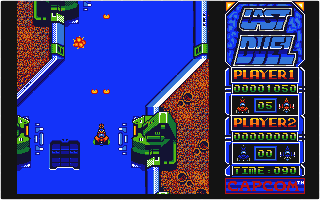
    The thing about Last Duel is that it is not LED Storm. That’s a fact that somehow managed to slip my attention until about 10 minutes before recording my most recent video.

    The other thing about Last Duel is that it is yet another Atari ST arcade conversion that comes this close to being a good game.

    It’s got smooth (horizontal) scrolling, is responsive, colourful, nippy and pretty fun to play… at first. The accompanying tune is passable and the pixel art is decent, everything is very distinct and very quick and easy to read. There’s even a plot of sorts told in-game with cut scenes and everything.

    You start off as a car: overhead view, storming up the track and jumping obstacles and hazards (now you can see where the LED Storm confusion came from) while blasting enemy vehicles and turrets that get in your way. Picking up large golden letters will power you up to help you deal with the challenges ahead. If you manage to despatch the end-of-level boss in time and with lives intact you transform into a spaceship and take to the inky void to blast some more enemies.

    So far, so fun. But here’s the rub. Well, here’s multiple rubs. So many rubs that you could describe Last Duel as a little abrasive. First of all, the plague of so many ST arcade conversions rears its ugly head yet again: the single fire button. To jump, you press up and fire. But of course, you are pressing up and fire a lot to move forward while you are firing, so unintentional jumps pop off every few seconds. And you can’t pick up power-ups while airborn. I missed so many vital pickups this way. Then, the cardinal sin of shoot ‘em ups makes an appearance: cheap deaths from behind. 50 lashes to you, Mr Developer. Of course, you lose all your power-ups upon losing a life, and of course that incredibly jarring horizontal flip-scrolling from LED Storm is back in full effect. Exfoliating.

    I made a video of me playing it. There’s some info about the original, a chat about the plot and a look at some magazine reviews. You can watch the video here, if you like.

    So, in summary, there’s a lot to like here, but so many niggles that I find it impossible to recommend that you give Last Duel a try, dear reader. Oh well, on to the next…

  • Conversion Capers – IK+

    Punching nuts on five different formats

  • Top 10 Atari ST Hidden Gems

    A gem cannot be polished without friction

  • Capcom Atari ST Conversions

    Giants of the video games industry

  • Robocop 2

    I’d buy that for two dollars!