The Joy of Stacks – 9/11/25 – Super Sprinting | Historically inaccurate shooting | Lovely things to read and watch
Arcade conversions on the ST
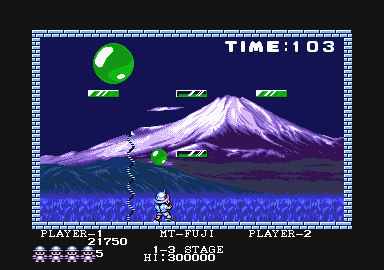
Here are some of my absolute favourite arcade conversions on the Atari ST:
Pang
Joust
Bubble Bobble
Super Sprint
Bombjack
Volfied
Rodland
Notice anything? I mean, apart from my undeniably good taste… Yes, that’s right! All of these games are single screen games that involve absolutely no scrolling whatsoever.
The ST is a notoriously stubborn beast when it comes to corralling it to scroll (have a look at what Jonas has to say about coding planar graphics via the link at the bottom of this newsletter for hint as to why). Not that scrolling is completely out of the question on the ST. There are plenty of examples of ST games and demos doing it as smooth as butter, but there is no doubting that many developers struggled to get it working adequately on our favourite rhombus keyed wonder. Just look at the recent videos of Capcom games on my channel (LED Storm and Last Duel) to see how some developers deal with this difficulty. Flipping hell.
So I think it comes as no surprise that some of the best arcade conversions on the machine, and some of the best games full stop (you can add Llamatron and IK+ to the above list) do not demand the developers run the gauntlet in order to get smooth horizontal movement. In the interests of balance, I’ve heard many programmers wax lyrical about the joys of developing on a system with open architecture like the ST has. Just you, your coding environment and the bare metal. It’s what a hacker’s dreams are made of. So the lack of scrolling hardware is a curse to some, but a boon to others.
I think the ST’s hurried and low-cost conception has a lot to do with this. It was brought to market quickly, and using many off-the-shelf parts and an OS hastily found and modified, not specifically made for the system. There was to be no dedicated hardware for sprites or scrolling. At the time of release, arcade games were not that demanding, especially for a 16-bit 8Mhz processor such as the Motorola 68000, but the arcades were rapidly developing. At the time of the ST’s release, the most popular arcades were games like Yie Ar Kung Fu, Bomb Jack and Punch Out, but in just a few short years, Final Fight, Strider and Golden Axe were more typical of what was popular in arcades; games that rely on throwing large sprites around on moving backgrounds to deliver the thrills and spills the more discerning arcade gamer demanded.
Sometimes I feel the ST was designed for the early to mid 80s. Didn’t stop me from falling in love with one in 1988, though.
This Week’s Joy of Sticks Videos
This one is the second video in the ‘Conversion Capers’ series. It’s a series where I look back at a favourite ST game of mine and then see how it runs on a variety of other systems.
The other versions of Super Sprint are not as consistent as they were for IK+ (last week’s Conversion Capers) but they are still really well put together and there is plenty of fun to be found.
Moving on to the next Capcom conversion on the Atari ST. This week it’s 1943 – The Battle of Midway. The arcade version is a seminal shoot ‘em up (despite what the reviewers say, spoiler alert) and it’s interesting to find out what features make it across to the ST version and which ones do not. It’s once again a case of close, but not quite.
The Sunday Papers

Here are some words and pictures that I enjoyed looking at this week:
First up, an amazing article from Jonas (author of STDoom) on learning to love and code for the Atari ST.
Apparently, a Graphics Environment Manager cannot be polished without friction. Take a look at Nemanja’s history of the GEM desktop environment.
Retro Dream posts the most gorgeous looking photographs of STs playing classic games on a CRT monitor. Mmm… scanlines…
Want to see someone in their basement completing the amazing Switchblade on the ST? Of course you do!
It’s not a walkthrough, playthrough, review, anything like that. It’s just Steve Benway playing Ghouls ‘n’ Ghosts badly so you can see what it looks like.
Leave a Reply